Steep slope
Slate, tile and historic roofing
Steep-slope installation and repair for slate, tile, asphalt shingle and historic roofs, with the sheet metal worked in alongside the roofing.
Chapter 01
Slipped slates, failed fasteners and the patch that never matches
A slate roof rarely fails all at once. It loses a slate here and another there, and nearly every loss starts at the fastener. Slates hang on nails or hooks, and when a nail rusts through or a hook lets go, the slate slides out of its course and leaves a gap that is open to wind-driven rain. Cracked and delaminating slates are the second pattern, usually from foot traffic, ice or a limb coming down. Tile fails in its own way: broken pieces, displaced courses, cracked ridge caps and mortar that has let go.
Much of this can be read from the ground. Slipped slates show up as crooked courses or dark gaps. Staining below a gutter or at a valley says water is running where it should not. The patch is where a good repair and a bad one part ways. A new slate set among aged ones in a different color, thickness or texture shows from the street, and one held with a surface nail or a smear of sealant is a leak waiting to be found. A repair on a steep roof should disappear into the course around it.
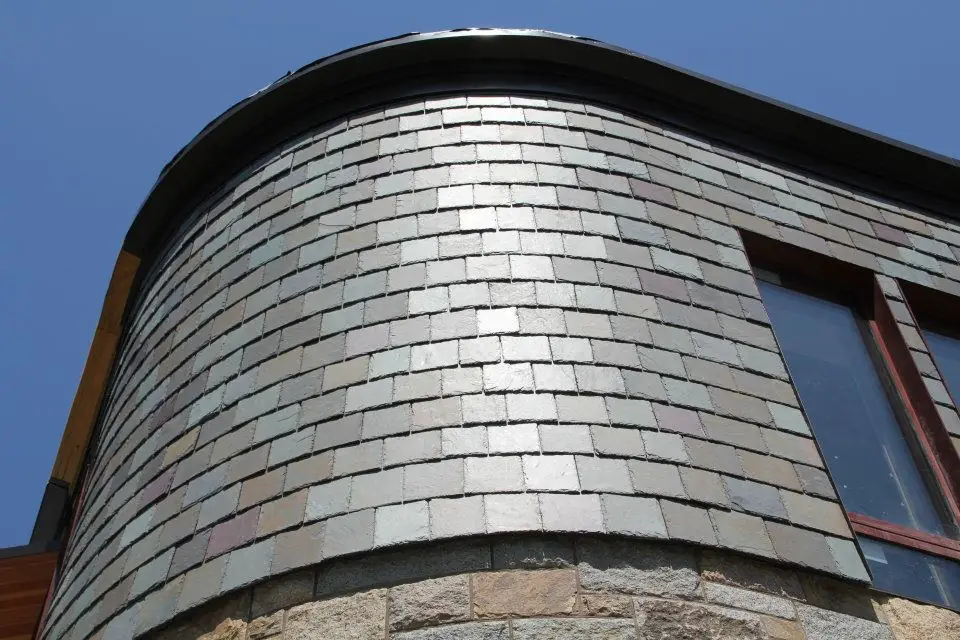
Curved turret wall clad in grey slate under a clear blue sky
Hooks, copper nails and valleys: how a steep-slope job goes together
A&M installs steep-slope roofing in slate and tile, asphalt shingles and historic roofing, and repairs slate, metal and tile roofs. Replacing a single slate is careful work. The broken piece is cut free at its fasteners without disturbing the courses around it, a new slate is slid into the gap, and it is held with a hook or strap in the joint where no nail head is left exposed to the weather. The fasteners on a slate roof should outlast the slate, which is why copper and stainless steel are the usual choices and plain steel nails are so often the culprit when an old roof starts shedding.
Valleys, hips and ridges carry the most water and take the most wind, so they are built around the metal. An open valley is lined with sheet metal formed to the slope, with the slates cut clean along its edges so water has a straight path to the eave. Metal fabrication sits next to roofing in A&M's work, which means flashings can be made for the roof they sit on instead of bent to fit from stock.
Clay and concrete tile are heavy and brittle, so tile repair means spreading load with boards and working course by course instead of walking the field. Underlayment and battens get checked as the broken tile comes off, because a cracked tile is sometimes the visible sign of a problem underneath it.
Chapter 03
Towers, dormers and curved walls take their own flashing
On a historic building the roof is won or lost in the details. A turret wall that curves, a dormer cheek meeting the main slope, a tower cap, a chimney with a saddle behind it: each needs counterflashing cut into the masonry or siding, step flashing woven into each course, and metal bent to the shape of the building rather than flattened against it. Slate and copper are also part of what these buildings look like, so matching the existing material matters for appearance as much as for performance.
After the work comes the inspection record. A&M maintenance inspections cover the sheet metal, flashings, drains and gutters along with the roof surface, and the written report with photo documentation shows what changed between visits. On a slate or tile roof that is how a loose slate gets caught while it is still a loose slate. Questions about a specific roof can go to the estimating team in Andover at (978) 475-4500.
Steep-slope installation for slate and tile, asphalt shingles and historic roofing, plus repairs on slate, metal and tile roofs. Roofing and sheet metal work since 1978.