What a Commercial Roof Maintenance Visit Should Leave You With
The value of a roof visit is the paper trail and the cleared drains it leaves behind, not the hour someone spent walking the membrane.
October 14, 2026 · 4 min read
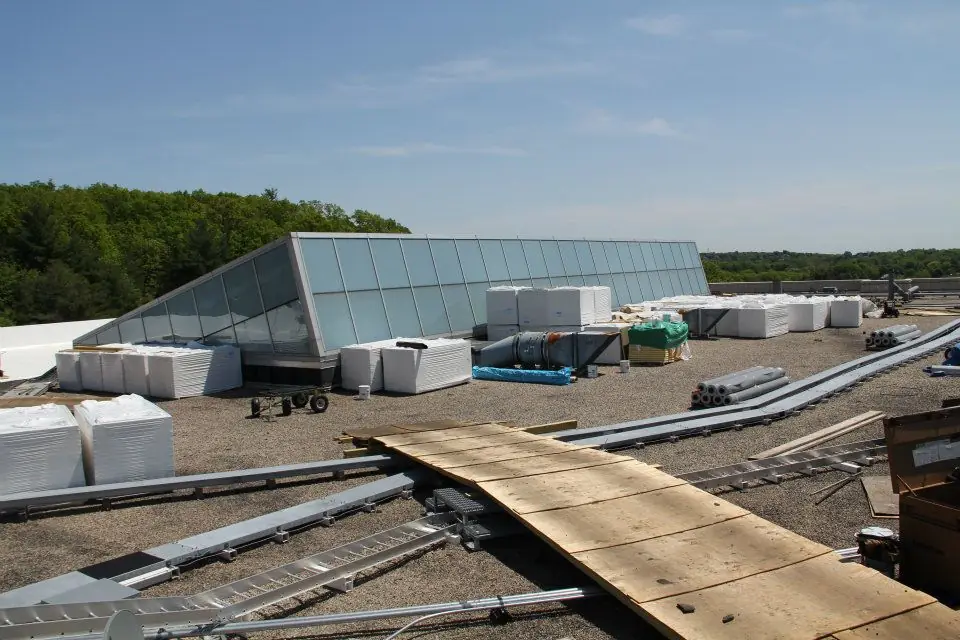
A lot of building owners treat roof maintenance as a box on a calendar: someone goes up, someone comes down, an invoice arrives. If you can't point to anything afterward, you paid for a walk, not a service. A proper maintenance visit leaves you with specific, checkable things, and knowing what they are makes it easy to tell a thorough crew from a casual one.
The inspection itself
The crew should look at the whole roof system, not just the open field of the membrane. That means the membrane surface, the flashings at walls, curbs and pipe penetrations, the sheet metal such as coping and edge metal, and the drainage: roof drains, gutters, scuppers and downspouts. Each of those fails in its own way, and a leak that shows up in a stockroom often starts at a detail nowhere near the stain.
Inspectors also look for what wears a roof out indirectly. A&M Roofing Services builds its maintenance visits around four observations: drainage, roof traffic, weather damage and moisture infiltration. Traffic matters because rooftop equipment brings technicians, and technicians wear paths into a membrane that was never meant to be a walkway. Moisture matters because a roof can look fine on top while the insulation below slowly gets wet.
Documentation you should be able to hold
The most useful output of a visit is the record. Ask for these items every time:
- A written report that describes the condition of each part of the roof in plain language
- Photo documentation tied to specific locations, so a cracked flashing is a labeled picture and not a verbal description
- A roof plan, meaning a simple drawing of the roof with problem areas marked and numbered
- A list of what was repaired during the visit and what was left for later
Those pages become your baseline. When the same corner shows up in three consecutive reports, you have evidence of a pattern. When a tenant says the roof was fine last spring, you have dated photos. When it's time to ask for budget, you have more than a hunch, and whoever inherits the building after you has a history to start from.
Drains, gutters, conductor heads and roof leaders
Debris removal is the unglamorous part of maintenance and arguably the most valuable. Leaves, grit, windblown trash and the occasional tennis ball collect around drains and in gutters. Conductor heads, the collection boxes at the top of downspouts, and the roof leaders that carry water down through the building can clog just as easily. Once water has nowhere to go, it sits, and a flat roof that holds water is working against its own design.
A maintenance package from A&M includes clearing debris from drains, gutters, conductor heads and roof leaders as part of the visit, not as an add-on. When you review a proposal from any contractor, look for that line. If it's missing, ask who clears the drains and how often.
Small repairs on the spot
Minor deficiencies are best fixed while the crew is already on the roof: a lifted seam edge, a failed sealant bead, a loose piece of coping, a fastener backing out. Repairing these during the visit stops a small issue from becoming an interior leak, and the report should say what was done so nothing is left to memory. If a crew finds something bigger than a minor fix, you should hear about it that day, with a photo, not three weeks later in a summary.
A schedule and a budget conversation
A one-off visit helps, but the pattern is what protects a building. A good provider will propose an inspection schedule and a repair program tailored to your roof, taking into account how much traffic it sees, what's mounted on it and how it has weathered. Seasonal timing matters in this region. Many facility teams like a visit in the fall, before the first snow, and another after the thaw to catch winter damage.
The last piece looks ahead. A good report tells you whether major repairs or a replacement are on the horizon so you can plan the budget instead of reacting to an emergency. That budgeting guidance is part of A&M's maintenance packages, alongside the inspection, documentation, debris removal and minor repairs.
How to hold your roofer to it
Before your next visit, tell the crew what you expect to receive and when. Ask for the report within a few days, ask where the photos are filed, and keep the roof plans together in one folder so a new facility manager or a new school business official can find them. Maintenance is only as good as the records behind it.
Want a roof visit that ends with paper you can use? Call A&M Roofing Services at (978) 475-4500 or write to estimating@amroofing.net. Same-day service and repair are available, and estimates are free.
A&M Roofing Services, (978) 475-4500
Call (978) 475-4500More articles
EPDM vs TPO vs PVC: Choosing a Single-Ply Membrane for a Commercial Roof
The right single-ply membrane depends on what your roof has to put up with, far more than on any brand name.
Ponding Water, Blocked Drains and the Slow Leak: Reading a Flat Roof After a Storm
Most flat roof damage announces itself on the roof long before it shows on a ceiling, if you know where to look.