EPDM vs TPO vs PVC: Choosing a Single-Ply Membrane for a Commercial Roof
The right single-ply membrane depends on what your roof has to put up with, far more than on any brand name.
October 14, 2026 · 4 min read
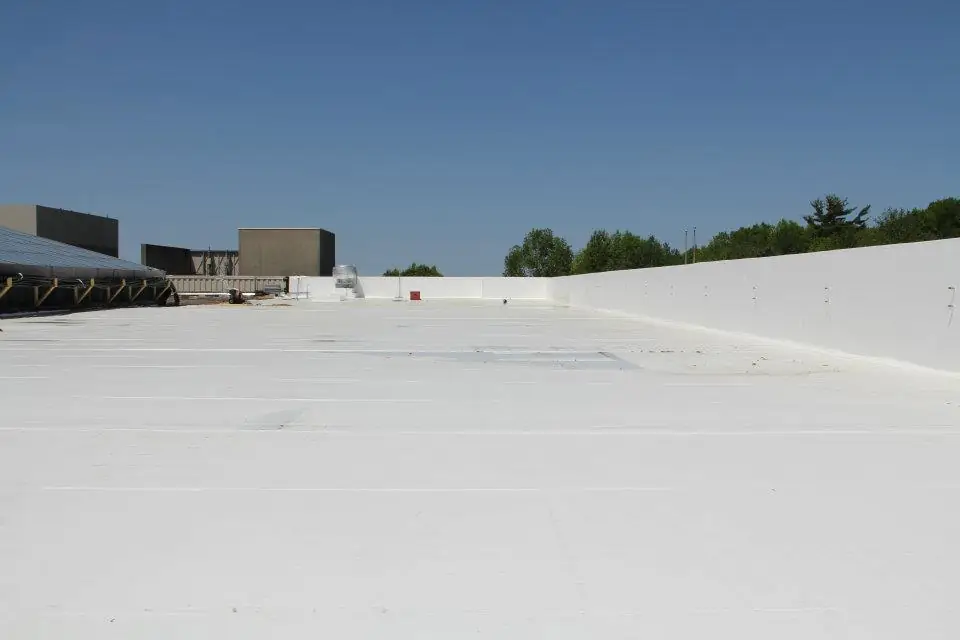
Walk a dozen commercial roofs in Massachusetts or New Hampshire and most of the low-slope ones will be covered in a single-ply membrane. From a loading dock the sheets look much alike, but EPDM, TPO and PVC behave differently once they're on the roof. If you manage a school, a retail strip or a light manufacturing plant, it pays to understand those differences before you start collecting bids, because the membrane you choose shapes how the roof is installed, detailed and maintained.
What single-ply actually means
A single-ply roof is a factory-made sheet, rolled out over insulation and a substrate, then attached and sealed at the seams. That's the whole idea: one layer of waterproofing instead of the several mopped or torched layers of a built-up roof. A sheet is only as good as its seams, its flashings at walls and curbs, and the attachment underneath it. Material choice matters, but workmanship at the details decides most leaks.
There are three common ways to hold the sheet down. Mechanically fastened systems use plates and screws through the membrane into the deck. Fully adhered systems glue the sheet to the insulation. Ballasted systems rely on stone or pavers laid over the membrane. Your structure, wind exposure and rooftop equipment all influence which method makes sense, and a roofer should check what the deck can carry before anyone proposes ballast.
EPDM: the rubber sheet
EPDM is a synthetic rubber membrane, usually black, supplied in wide rolls that keep the number of field seams down. Because it's flexible, it tolerates the expansion and contraction of a New England winter without much fuss. Seams are joined with tape or adhesive rather than heat, which lets a crew detail awkward shapes by hand and work through a wide range of conditions.
The tradeoffs are worth knowing. A black surface absorbs heat, so a building with heavy cooling demand may be better served by a white membrane. Adhesive seams also depend on clean surfaces and careful installation, which is one more reason to ask who will actually be doing the work and how they check their seams before leaving the roof.
TPO: the heat-welded white roof
TPO is a thermoplastic sheet, most often white, with seams welded together by hot air. A welded seam fuses two sheets into a single piece instead of gluing them. The reflective surface is why TPO shows up so often on retail and office buildings that want to reduce solar heat gain through the roof.
TPO formulations differ from one manufacturer to the next, and the product has changed as makers refined their recipes. That's a good reason to ask which specific membrane and thickness is on the bid, and to buy from a manufacturer your roofer is licensed with. The license matters because the manufacturer sets the installation standards and stands behind the warranty program.
PVC: the chemical-resistant option
PVC is also heat-welded and typically white or light gray. What sets it apart is how it responds to whatever lands on the roof. Restaurant exhaust, kitchen grease and some process vapors can attack certain membranes, and PVC is commonly specified where those exposures exist: food service buildings, labs and manufacturing plants. If your roof has exhaust fans dropping grease or chemical residue onto the surface, say so to every bidder at the start.
PVC sheets contain plasticizers that keep them flexible, and manufacturers handle that differently. Compare the product data sheets instead of assuming every PVC membrane performs alike.
Questions that settle the choice
Instead of asking which membrane is best, ask what your roof has to put up with. These questions help an estimator give you a straight answer:
- What is vented or exhausted onto the roof, and does any of it carry grease or chemicals?
- How much foot traffic does the roof see from HVAC technicians, window cleaners or tenants' contractors?
- Is the existing insulation dry and sound, or does it need to be replaced along with the membrane?
- Do cooling costs or a reflective surface matter for this building?
- How many penetrations, curbs and odd corners does the roof have, since each one is a flashing detail?
- Which manufacturer warranty options are available, and who is licensed to install them?
Price per square foot isn't on that list. It belongs in the conversation, but only after the scope is clear, because two bids that look far apart often cover different insulation, different attachment or different flashing work.
Matching the installer to the manufacturer
Single-ply manufacturers certify their contractors, and that certification decides who can offer their warranty programs. A&M Roofing Services specializes in single-ply installation and is licensed by Carlisle, Sika-Sarnafil, Firestone, Johns Manville and Duro-Last. That lets a facility manager compare EPDM, TPO and PVC options with one crew, rather than being steered toward whatever a single manufacturer sells. A&M installs roofs to meet or exceed the manufacturer's specifications, and the work is covered by warranty.
Whatever you choose, get the membrane type, thickness, attachment method and flashing details written into the proposal. Those lines are what you'll compare between bidders, and what you'll point to if a question comes up after the crew has left.
For a free estimate on a commercial roof in Massachusetts or New Hampshire, call A&M Roofing Services at (978) 475-4500 or email estimating@amroofing.net.
A&M Roofing Services, (978) 475-4500
Call (978) 475-4500More articles
What a Commercial Roof Maintenance Visit Should Leave You With
The value of a roof visit is the paper trail and the cleared drains it leaves behind, not the hour someone spent walking the membrane.
Ponding Water, Blocked Drains and the Slow Leak: Reading a Flat Roof After a Storm
Most flat roof damage announces itself on the roof long before it shows on a ceiling, if you know where to look.